When retail crime escalates from stolen merchandise to violence against employees, the consequences extend far beyond financial losses. It raises an important question about how retailers and law enforcement communicate, coordinate, and respond.
In October 2026, the Surrey Police Service (SPS) announced an arrest following a series of alleged smash-and-grab robberies targeting electronics retailers across Surrey.
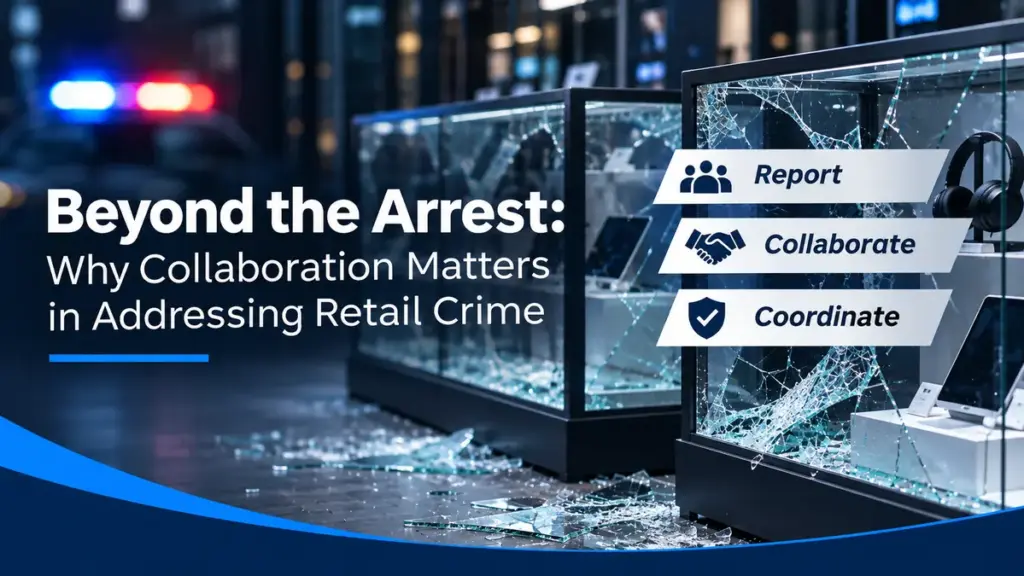
Between June and October, the reported incidents involved damaged display cabinets, alleged assaults against retail employees, and substantial merchandise losses. According to SPS, the estimated combined value of stolen merchandise and property damage was approximately $100,000.
The investigation, led by the SPS Prolific Offender Unit, resulted in the arrest of one individual who subsequently faced 17 approved charges related to the alleged robberies, with additional firearms-related charges arising from the arrest.
With charges now before the courts, the case reflects the investigative efforts of the SPS Prolific Offender Unit and the important role of law enforcement in addressing serious retail crime.
While the arrest highlights the importance of timely reporting, strong relationships and coordinated efforts, it also draws attention to a broader issue: retail crime frequently presents challenges that extend beyond individual businesses.
When incidents occur across multiple locations, the ability to recognize patterns, communicate relevant information and maintain established relationships with law enforcement becomes increasingly important.
These connections help ensure that relevant information does not remain isolated and can reach those responsible for assessing and responding to criminal activity.
From Isolated Incidents to Industry Awareness
Retail crime carries consequences beyond the merchandise taken. According to Retail Insider’s October 2026 Security & Loss Prevention Report, Canada recorded 208,941 police-reported shoplifting incidents in 2025, with the population-adjusted rate increasing 11% from the previous year. Behind those numbers are employees facing difficult situations, businesses managing losses and communities concerned about safety.
Yet one of the industry’s greatest challenges is not always the lack of information. Sometimes, it is the lack of connection between those who hold it. A retailer may recognize a recurring problem within its own stores without knowing whether neighbouring businesses are experiencing similar incidents.
One report may appear isolated. Several reports, when appropriately assessed together, may reveal something more significant. That does not mean every incident is connected. It means that better reporting can support better recognition of potential patterns.
At the 2026 Downtown Vancouver Community Safety Forum, retailers, law enforcement and community partners came together to discuss challenges affecting public safety and the retail environment. The discussions highlighted the importance of stronger relationships, responsible information sharing and continued cooperation.
No single retailer, police agency or industry organization has a complete picture of every challenge. The broader perspective comes from bringing different experiences, expertise and information together.
From Communication to Coordination
When collaboration is discussed in public safety, the challenge is turning conversation into coordinated action. For retailers, that begins with clear reporting procedures, accurate documentation, and employees who understand how to respond safely while following company policy. It also requires knowing when, where, and how relevant information should be reported.
For law enforcement, timely and reliable reports can help investigators assess incidents, identify possible connections and determine appropriate next steps.
Clear reports. Consistent communication. Coordinated responses.
A recent example comes from the Vancouver Police Department‘s Retail Crime Task Force (VPD RCT). After hearing concerns from loss prevention professionals about challenges with the existing reporting process, the VPD RCT took steps to introduce a more streamlined online reporting process for eligible shoplifting After the Fact Charges (ATFCs).
The revised process was designed to make reporting more accessible and user-friendly while maintaining appropriate reporting channels for incidents requiring a different police response.
This is an example of what collaboration can accomplish when concerns are heard, and practical solutions follow.
Collaboration Crossing Boundaries and the Nation
The importance of this approach extends beyond British Columbia. In October 2026, Peel Regional Police hosted an organized retail crime conference attended by representatives from nearly 60 police services, alongside retailers, government officials and industry partners.
The conference emphasized intelligence sharing, investigative coordination and partnerships across organizational and jurisdictional boundaries. These examples reinforce an important point: collaboration works best when communication moves in both directions.
Retailers have operational experience and firsthand knowledge of the challenges they face. Law enforcement brings investigative expertise and an understanding of the information needed to support effective police responses.
When those perspectives come together, the result can be more than shared awareness. It can lead to meaningful improvements in how organizations work together.
Stronger Networks, Safer Stores
The recent Surrey case offers an opportunity to reflect on the value of connections within the retail community. When retailers understand the importance of timely reporting and have established channels for communicating relevant information, they are better positioned to support an informed response.
In British Columbia, networks such as ORCA BC help connect retailers, loss prevention professionals, law enforcement and community partners. These relationships create opportunities to raise awareness, share industry knowledge and encourage responsible reporting.
The distinction between industry collaboration and police investigations remains important. Retailers and professional networks can bring relevant information forward. Police assess that information, conduct investigations and make enforcement decisions. Both have important responsibilities, and both contribute to the broader public safety effort.
We recognize the SPS Prolific Offender Unit and the officers involved for their work on this case, particularly given the serious allegations of violence against retail employees.
Stronger networks do not replace police work. They help create the connections through which relevant information can reach police.
An arrest may mark an important development in one case. The broader opportunity is to strengthen the communication and cooperation that help organizations respond when similar challenges arise.
Crime can cross boundaries. Our communication cannot afford to stop at them.
Safer Stores. Safer Communities. Stronger BC.
This article discusses publicly reported allegations and enforcement developments. Criminal charges have not been established as findings of guilt.